Laguna Art Gallery Artist That Builds His Own Frames From Scrap
| Richard Serra | |
|---|---|
 Richard Serra portrayed past Oliver Mark, Siegen 2005 | |
| Born | (1938-11-02) Nov 2, 1938 San Francisco, California, U.S. |
| Nationality | American |
| Education | University of California, Berkeley (attended) Academy of California, Santa Barbara (B.A. 1961) Yale University (B.F.A. 1962, G.F.A. 1964) |
| Movement | Process Fine art |
| Spouse(s) | Nancy Graves (grand. 1965; div. 1970) Clara Weyergraf (m. 1981) |
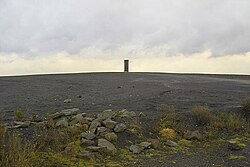
Bramme for the Ruhr-District, 1998 at Essen

Richard Serra (born Nov 2, 1938) is an American artist known for his big-scale sculptures made for site-specific landscape, urban, and architectural settings. Serra'southward sculptures are notable for their fabric quality and exploration of the relationship between the viewer, the work, and the site. Since the mid-1960s, Serra has worked to radicalize and extend the definition of sculpture beginning with his early experiments with safe, neon, and lead, to his large-scale steel works.
Early life and teaching [edit]
Serra was built-in in San Francisco, California to Tony and Gladys Serra – the second of three sons. From a young age, he was encouraged to draw by his female parent. The young Serra would behave a pocket-sized notebook for his sketches and his mother would introduce her son as "Richard the artist."[1] His father worked equally a pipe fitter for a shipyard near San Francisco. Serra recounts a retention of a visit to the shipyard to encounter a boat launch when he was iv years sometime. He watched as the ship transformed from an enormous weight to a buoyant, floating structure and notes that: "All the raw material that I needed is contained in the reserve of this retentiveness."[2]
Serra studied English language literature at the University of California, Berkeley in 1957 before transferring to the Academy of California, Santa Barbara and graduating in 1961 with a BA in English Literature. In Santa Barbara, Serra met the muralists, Rico Lebrun and Howard Warshaw. Both were in the Art Section and took Serra under their wing.[3] During this time, Serra worked in steel mills to earn a living.[four]
Serra studied painting at Yale University and graduated with both a BA in Art History and an MFA in 1964. Fellow Yale alumni include Chuck Close, Rackstraw Downs, Nancy Graves, Brice Marden, and Robert Mangold.[5] At Yale Serra met visiting artists from the New York School such as Philip Guston, Robert Rauschenberg, Ad Reinhardt, and Frank Stella. Serra taught a color theory grade during his last year at Yale and subsequently graduating was asked to aid proof Josef Albers' notable color theory book "Interaction of Color."[v] [half dozen]
In 1964, Serra was awarded a 1-year traveling fellowship from Yale and went to Paris where he met the composer Philip Glass[5] who became a collaborator and long-fourth dimension friend. In Paris, Serra spent time sketching in Constantine Brancusi's studio, partially reconstructed inside the Musée national d'art modern on the avenue President Wilson,[five] allowing Serra to study Brancusi'southward work, afterwards drawing his own sculptural conclusions.[7] An verbal replica of Brancusi's studio is now located opposite the Center Pompidou.[eight] Serra spent the following year in Florence, Italian republic on a Fulbright Grant. In 1966 while yet in Italian republic, Serra made a trip to the Prado Museum in Spain and saw Diego Velazquez's painting, "Las Meninas."[8] The artist realized he would not surpass the skill of that painting and made the decision to move away from painting.[1]
While still in Europe, Serra began experimenting with nontraditional sculptural fabric. He had his first one-person exhibition "Animate being Habitats" at Galleria Salita, Rome.[9] Exhibited there were assemblages made with live and stuffed animals which would be referenced as early piece of work from the Arte Povera motility.[2]
Work [edit]
Early work [edit]
Serra returned from Europe and moved to New York City in 1966. He continued his constructions using experimental materials such every bit rubber, latex, fiberglass, neon, and pb.[10] His Chugalug Pieces were made with strips of condom and hung on the wall using gravity equally a forming device. Serra combined neon with continuous strips of prophylactic in his sculpture Belts (1966–67) referencing the serial abstraction in Jackson Pollock's Mural (1963.) Around that fourth dimension Serra wrote Verb List (1967) a list of transitive verbs (i.e. cast, whorl, tear, prop, etc.) which he used as directives for his sculptures.[eleven] To Lift (1967), and Thirty-Five Feet of Pb Rolled Upward (1968), Splash Piece (1968), and Casting (1969), were some of the action-based works with origins in the verb listing. Serra used lead in many of his constructs because of its adjustability. Lead is malleable enough to exist rolled, folded, ripped, and melted. With To Lift (1967) Serra lifted a 10-foot canvass of rubber off the ground making a free-standing form; with Xxx-five Feet of Pb Rolled Upwardly (1968), Serra, with the help of Philip Glass, unrolled and rolled a canvas of lead every bit tightly as they could.[11]
In 1968 Serra was included in the grouping exhibition "Nine at Castelli" at Castelli Warehouse in New York[12] where he showed Prop (1968), Scatter Piece (1968), and made Splashing (1968) by throwing molten lead against the angle of the floor and wall. In 1969 his piece Casting was included in the exhibition Anti-Illusion: Procedures/Materials at the Whitney Museum of American Art in New York.[12] In Casting the artist again threw molten lead against the bending of the floor and wall. He so pulled the casting made from the hardened lead away from the wall and repeated the action of splashing and casting creating a series of free-continuing forms.[13]
"To prop" is another transitive verb from Serra's "Verb List" utilized by the creative person for a series assemblages of lead plates and poles dependent on leaning and gravity every bit a force to stay upright.[13] Serra'southward early Prop Pieces such every bit Prop (1968) relied mainly on the wall as a support.[14] Serra wanted to move away from the wall to remove what he thought was a pictorial convention. In 1969 he propped four lead plates up on the floor like a house of cards. The sculpture 1 Ton Prop: Firm of Cards (1969) weighed 1 ton and the four plates were self-supporting.[15]
Another pivotal moment for Serra occurred in 1969 when he was commissioned by the artist Jasper Johns to make a Splash Piece in Johns'due south studio. While Serra heated the pb plates to splash against the wall, he took ane of the larger plates and fix it in the corner where it stood on its own. Serra'due south suspension into space followed shortly later on with the sculpture Strike: To Roberta and Rudy (1969–71).[xvi] Serra wedged an 8 past 24-foot plate of steel into a corner and divided the room into two equal spaces. The work invited the viewer to walk effectually the sculpture, shifting the viewer'due south perception of the room every bit they walked.[13]
Serra get-go recognized the potential of working in large scale with his Skullcracker Series made during the exhibition, "Art and Technology," at the L.A. County Museum of Art in 1969. He spent ten weeks edifice a number of ephemeral stacked steel pieces at the Kaiser Steelyard. Using a crane to explore the principles of weigh and gravity, the stacks were as tall as thirty to 40 anxiety loftier and weighed between 60 and 70 tons. They were knocked down by the steel workers at the end of each mean solar day. The calibration of the stacks allowed Serra to brainstorm think of his work exterior the confines of gallery and museum spaces.[17]
Landscape works [edit]

In 1970 Serra received a Guggenheim Fellowship and traveled to Japan. His get-go outdoor sculptures, To Encircle Base of operations Plate (Hexagram) (1970) and Sugi Tree (1970), were both installed in Ueno Park as part of the "Tokyo Biennale."[eighteen]
While in Nihon, Serra spent most of his fourth dimension studying the Zen gardens and temples of the Myoshin-ji in Kyoto. The layout of the gardens revealed the landscape equally a full field that can simply exist experienced by walking. The gardens changed Serra'south way of seeing space in relation to time.[xix] Upon returning to the US he built his first site-specific outdoor work: To Encircle Base Plate Hexagram, Right Angles Inverted (1970). Hither Serra embedded two semi-round steel flanges, forming a band 26 feet in diameter, into the surface of 183rd Street in the Bronx. One semi-circle measured 1 inch wide and the 2nd, 8 inches wide. The work was visible from two perspectives: either when the viewer came directly upon it or from above on a stairway overlooking the street.[twenty]
Throughout the 1970s Serra continued to brand outdoor site-specific sculpture for urban areas and landscapes Serra's was interested in the topology of landscape and how one relates to it through movement, space, and time. His first landscape work was made in late 1970 when Serra was commissioned past the art patrons Joseph and Emily Rauh Pulitzer to build a sculpture on their belongings outside St. Louis, Missouri. Pulitzer Piece: Stepped Peak (1970–71) was Serra's first big-scale landscape work. Iii plates measuring five feet high by 40 to fifty feet long were placed beyond approximately 3 acres. The placement of the plates was determined by the fall of the mural. Each plate was impaled into the ground far enough until its rise was 5 feet. Serra'southward intention was for the plates to human activity equally cuts in the mural that function as surrogate horizons every bit viewers walked amongst them.[21]
Shift (1970–72), Serra's second attempt in the mural, was built in a field owned by the collector Roger Davidson in King Urban center, Ontario. The sculpture is composed of six rectilinear concrete sections placed forth the sloping landscape. [17] In 2013 Shift was designated a Heritage Site nether the Ontario Heritage Human activity. Shift, like Pulitzer Piece, was based on the elevational fall of the land over a given distance. The top edges of the plates function as a horizon being placed into specific elevational intervals as you walk the entire field.[22]

Serra'southward subsequent site-specific works in landscape continued to explore the topography of the state and how the sculpture relates to this topography past mode of motion, meditation, and perception of the viewer. Among the almost notable of the landscape works are Porten i Slugten (1983–86) in Louisiana Museum of Modern Art, Kingdom of denmark;[23] Afangar (Stations, Stops on the Road, To Cease and Expect: Forward and Back, To Take It All In) (1990) in Videy Island, Iceland;[24] Schunnemunk Fork (1991) in Storm Rex Art Center, New York;[25] Snake Eyes and Box Cars (1993) in Sonoma County, California;[26] Te Tuhirangi Contour (2000-2) in Kaipara, New Zealand;[27] and East-Westward/West-East (2014) in Qatar.[28] The sculpture Porten i Slugten (1983–86) was deputed for the Louisiana Museum of Modernistic Art, Humlebaek, Denmark. After walking the museum grounds, Serra chose a ravine that runs towards the Kattegat Sea equally the site for his sculpture. The ravine was the only area in the grounds that had non been landscaped. 2 plates were set at an bending to each other at the end of a sloping stretch of path which fronts the ravine. The plates role in their location like a gate which opens as the viewer walks downwardly the path towards the bounding main. Seen from the center of a bridge, which crosses the ravine and leads to the museum, the two plates form a single plane as if the gate had closed. As you walk downwardly from the museum to the sea below, the plates announced to have a continuous swinging motility.[29]

In 1988 Serra was invited by the National Gallery of Republic of iceland to build a piece of work. Serra chose Videy Isle as the site for Afangar (Stations, Stops on the Road, To Stop and Look: Forward and Dorsum, To Have It All In) (1990). The sculpture is comprised of nine pairs of basalt columns (a material indigenous to Iceland) and placed forth the periphery of Vesturey, the northwest part of the island. All nine locations share the same elevations in that the stones of each pair are situated at an tiptop of 9 and ten meters, respectively. Each set of stones is level at the top. All stones at the higher elevation mensurate 3 meters; all stones at the lower pinnacle measure out iv meters. Considering of the variance of topography, the stones in a ready are sometimes closer together, sometimes further apart. The ascension and fall of Videy Isle and the surrounding mural is seen against the fixed mensurate of the standing stones.[30] The stones are visible along the horizon of the island and orient the viewer against the ascent and fall of the surrounding mural.[31]
Te Tuhirangi Contour (2000-two) is located on vast open up pasture on Gibbs Farm in Kaipara, New Zealand. The sculpture stands 20 feet high and spans 844 anxiety as one continuous contour that follows the rolling hills, expansion, and contraction of the landscape. The sculpture'southward elevation is perpendicular to the fall of the land.[32]
Due east-West/West-Due east (2014), located on an East-Due west axis in the Brouq Nature Reserve in Qatar, was commissioned by Sheika al-Mayassa al-Thani of Qatar. It consists of 4 steel plates either 54 3/iv or 48 ane/2 feet high. The plates are placed at irregular intervals in a valley that runs between two gypsum plateaus. The plates are level to each other and the tiptop of the adjacent plateaus. The piece of work spans less than a kilometer and all plates are visible from either end.[33]
Urban works [edit]
In the mural, the sculptural elements draw the viewer's attention to the topology of the land as its walked. Serra'due south site-specific Urban sculptures focus the viewer'due south attention on the sculpture itself. Their locations often more attainable to the public than the landscape works, invite the viewer to walk inside, pass through and move around them.[34] Considering of the confines of Urban architecture, sculptures such equally Sight Point (1972–75) at the Stedelijk Museum, The netherlands; Terminal (1977) in Bochum, Germany; T.Westward.U. (1980) at the Deichterhallen, Hamburg, Germany; Fulcrum (1986–87), installed in Broadgate, London; Exchange (1996) exterior the City of Grand duchy of luxembourg; or 7 (2011) on a pier in Doha, Qatar, reflect the verticality of their surrounding architecture.[35] Outdoor sculptures like St. John'south Rotary Arc (1980) temporarily installed outside the Holland Tunnel entrance in New York Metropolis; Tilted Arc (1981) installed and later removed from New York City's Federal Plaza; Clara-Clara (1983), temporarily installed at Tuileries, Place de la Concorde, Paris; Berlin Junction (1987) installed outside the Berlin Combo; are all curved forms or arcs that open up and close depending on the direction the viewer takes walking effectually them.[35]
Sight Bespeak (1972–75) was Serra's first vertical Urban work and a continuation of the remainder and counterbalance principles of his earlier work Prop.[36] Sight Point stands exterior the Stedelijk Museum, Amsterdam, Kingdom of the netherlands, consisting of three vertical steel plates 10 feet wide and 40 anxiety loftier that lean in at an angle and forming a triangular space on the ground with three openings that can be walked through. Once inside the viewer can look up and run across the heaven framed by the triangular shape made by the leaning plates.[37]
Some other vertical sculpture, Concluding (1977), was conceived for "Documenta Vi" in 1977. Information technology was permanently installed on a traffic island betwixt the street car tracks in front of a train station in Bochum, Federal republic of germany. Serra chose the site because of its proximity to a loftier traffic surface area.[38] Exchange (1996), sited in a vehicular round-about on peak of a highway tunnel, fabricated of seven trapezoidal plates. The sculpture stands 60 feet high and tin can be seen by drivers as they enter and leave the Urban center of Luxembourg.[39]
In 1980 Serra installed two sculptures, with back up of the Public Fine art Fund, in New York City. T.W.U. (1980) and St. John's Rotary Arc (1980) were each placed in areas where traffic and people converged. T.Westward.U, a vertical sculpture comprised of three vertical plates, each 36 feet high, was installed at a subway entrance virtually West Broadway between Leonard and Franklin Streets.[40] The sculpture is now permanently installed exterior the Deichterhallen, Hamburg, Frg.[41] St. John'south Rotary Arc, one of Serra's earliest curved sculptures, was 12 feet loftier and spanned 180 feet. From 1980-88 the site-specific sculpture was installed on the rotary at the entrance and go out to the Holland Tunnel.[42]
The following year in 1981, a second site-specific curved sculpture Tilted Arc (1981) was installed in New York City'southward Federal Plaza. Commissioned by the U.South. General Services Assistants'southward Fine art-in-Architecture Program following a rigorous selection process, the sculpture'due south arc spanned 120 feet and 12 feet loftier. The sculpture was a curve that tilted and leaned away from its base. It was anchored into the plaza at both ends so that the center of the sculpture was raised. Serra's intention for the sculpture was to draw pedestrians' attention to the sculpture as they crossed the plaza.[43] Tilted Arc was met with resistance by workers in the Federal building. An eight-year campaign to remove the sculpture ensued and Tilted Arc was ultimately removed on March 15, 1989.[44] In Serra'south defence force to preserve the sculpture he stated "To remove the work is to destroy the piece of work,"[45] advocating an art-for art's sake mantra of site-specific artworks. The instance of Tilted Arc continues to highlight the tension surrounding the nature of public art and its intended audience.[46]
The 67-foot-tall COR-X steel Vortex was installed exterior the Modernistic Art Museum of Fort Worth in 2002.[47]

Vortex Sculpture by Richard Serra at the Mod Art Museum Fort Worth, Texas
Gallery works [edit]
Serra has had numerous exhibitions in gallery and museum settings. His site-specific gallery installations are sometimes used to test ideas.[48] Serra's first US solo exhibition was at the Leo Castelli Warehouse, New York in 1969. There he exhibited 10 pb Prop Pieces, a Scatter Slice: Cutting Device: Base of operations Plate Measure (1969), and a Splash Piece: Splashing with Four Molds (To Eva Hesse) (1969).
Following his process-based works of the belatedly 1960s and early on 1970s, Serra began to solely use rolled or forged steel in his sculpture.[49] Berlin Block (for Charlie Chaplin) (1977) was Serra's first forged sculpture. Made for the plaza outside the Neue Nationalgalerie in Berlin, designed by Ludwig Mies van der Rohe, the sculpture weighs 70 tons.[x] Other forged sculptures include Elevation for Mies (1985-88) at Museum Haus Esters, Krefeld, Germany; Philibert et Marguerite (1985), in the Musee de Brou, Bourg-en-Bresse, French republic; Weight and Mensurate (1992), a temporary site-specific installation at the Tate Gallery, London; Santa Fe Depot (2004), in the Museum of Contemporary Art San Diego; and Equal (2015) in the Museum of Modern Fine art, New York.
Serra'southward most known series of sculpture using rolled steel plates are the Torqued Ellipses. In 1991 Serra visited Borromini's Church building of San Carlo alle Quattro Fontane in Rome and mistook the ovals of the dome and the flooring to be offset from 1 some other.[50] He idea to brand a sculpture in this torqued course. Serra constructed models of this perceived form in his studio past cutting two ellipse-shaped pieces of woods and nailing a dowel between them. He then turned the ellipses and then they were at a right angle to 1 another and wrapped a sheet of lead around the form. After making a template from the models Serra worked with an engineer to fabricate the sculptures.[51] In total there are seven Torqued Ellipses and four Double Torqued Ellipses (an ellipse within of an ellipse) dated betwixt 1996-2004.[52] Each sculpture has a different degree or torque and measures upwardly to 13 feet high. The sculptures all have an opening so that they can be walked through and around.[53] Three Torqued Ellipses are on permanent view at Dia Beacon, New York.[54]
In 2005 "The Affair of Fourth dimension," a commissioned installation, opened at the Guggenheim Museum, Bilbao, Spain. Comprised of eight sculptures spanning a decade from 1994-2005, "The Matter of Time" highlights the evolution of Serra'south sculptural forms. Serra chose to include five sculptures derived from the initial torqued ellipse: 1 unmarried, one double ellipse, and three torqued spirals.[55] The Torqued Spirals followed after the Double Torqued Ellipses when Serra decided to connect a double ellipses into one wound form that can be entered and walked through.[21] The remaining sculptures in "The Thing of Time" are one closed (Blind Spot Reversed) and one open up (Between the Torus and the Sphere) torus and spherical sculpture; and Serpent: fabricated of three parts, each comprising ii identical conical sections inverted relative to each other and spanning 104 anxiety overall. The sculptures are organized by Serra with intention. The direction which the viewer moves through the infinite creates a awareness of varying scale and proportion, and an sensation to the passing of fourth dimension.[56] [57]
In 2008 Serra participated in Monumenta, an annual exhibition held in Paris's Yard Palais featuring a single artist. For Monumenta Serra installed a single sculpture, Promenade (2008), comprised of five plates, each 55 feet tall and 13 feet wide, placed 100 feet apart from 1 another beyond the cavernous interior of the Grand Palais. Overall, the sculpture spanned 656 feet. The plates were not placed in a line just stood side to side off the Grand Palais'due south center axis. They tilted either left or right, leaned either toward or away from another, and the viewer as they strolled effectually them.[58]
The sculpture Equal (2014), in the drove of The Museum of Modernistic Fine art, New York, consists of 8 forged blocks. Each block measures v by five ½ by 6 feet and weighs 40 tons. The blocks are stacked in pairs and positioned on their longer or shorter sides and then that each stack measures xi feet tall.[59] When walking amongst the four stacks the viewer becomes aware of their own sense of weight, balance, and gravity in relation to the sculptures.[60]
Drawings [edit]
Cartoon is integral to Serra'south exercise. Serra makes drawings on large sheets of canvas or handmade paper. They include horizontal or vertical compositions; constructions of overlapping sheets; or line drawings.[61] His drawings are primarily done in paintstick, lithographic crayon, or charcoal and are always black. Serra experiments with unlike techniques and tools to manipulate and utilize the medium. He often pushes the conventions of drawing towards a tactile, phenomenological experience of movement, time and space.[62] The creative person has said that his cartoon practise is involved with "repetition, knowing there's no possibility of repeating, knowing that it's going to yield something dissimilar each time."[62]
Following his interruption into space with sculptures like Strike: To Roberta and Rudy (1969–71), Serra became interested in redefining architectural infinite with cartoon besides.[63] In 1974 Serra started to make his Installation Drawings—big-scale site-specific sheets of canvas completely covered in paintstick and stapled to the wall. The Installation Drawings cover the wall, or walls, of a given space.[64] Shafrazi and Zadikians were two of Serra's first Installation Drawings. Both were exhibited at Leo Castelli Gallery, New York in 1974 and measured approximately 10 ½ anxiety loftier and 18 anxiety wide overall.[65] Serra continued to make Installation Drawing throughout his career. Other notable drawing series include: Diptychs (1989); Expressionless Weight (1991–92); Weight and Measure (1993–94); Videy Afangar (1989–91); Rounds (1996–97); out-of-rounds (1999-2000); Line Drawings (2000-02); Solids (2008); Greenpoint Rounds (2009); Elevational Weights (2010); Rifts (2011–18); Transparencies (2011–13); Horizontal Reversals (2014) Rambles (2015–16); Composites (2016); Horizontals and Verticals (2016–17); Orchard Street (2018).[66]
National and international survey exhibitions of Serra's drawings include Richard Serra: Tekeningen/Drawings 1971-1977 at the Stedelijk Museum, Amsterdam in 1978; Richard Serra: Tekeningen/Drawings at the Bonnefantenmuseum, Maastrict in 1990; Richard Serra Drawings: A Retrospective at The Metropolitan Museum of Art, New York, the San Francisco Museum of Modern Art, and Menil Collection, Houston from 2011–12; and Richard Serra: Drawings 2015-2017: Rambles, Composites, Rotterdam Verticals, Rotterdam Horizontals, Rifts at the Museum Boijmans van Beuningen. Rotterdam, The Netherlands in 2017.[67]
Prints [edit]

Richard Serra, Level Iv, 2010, Ane color carving, 29 x 65 inches
Serra began making prints in 1972. Working closely with Gemini G.Due east.L. in Los Angeles, Serra developed unconventional printing techniques. He has made over 200 printed works and like his sculpture and cartoon, his prints reverberate an interest in process, scale, and experimentation with material.[68]
His early lithographs starting in 1972 include the prints Circuit; Balance; Eight by Eight; or 183rd & Webster Avenue, each titled later a sculpture created around the same time. In 1981 Serra produced his first lithograph series comprised of vii editions, titled: Sketch #i through Sketch #vii. That same year Serra begin to brand larger-scale prints such as Malcolm X; Goslar, or The Moral Majority Sucks. [69]
After pushing lithography to its limit, Serra began to piece of work with silkscreen to produce a unique surface in his prints. He did so past first applying a layer of ink onto the newspaper. He then would apply a layer of pigment stick through the second screen creating a saturated and textured surface.[70]
Serra continued to work this his silkscreen technique, sometimes combining it with etching and aquatint. Impress series include: Videy Afanger (1991); Hreppholer (1991); WM (1996); Rounds (1999); Venice Notebook (2001); Between the Torus and the Sphere (2006); Paths and Edges (2007); Level (2008); Junction (2010); Reversal (2015); Elevational Weight (2016); Equal (2018); and (2019).
Films and video works [edit]
From 1968-1979 Serra fabricated a collection of films and videos. Although he began working with sculpture and movie at the same time, Serra recognized the dissimilar material capacities of each and did not extend sculptural problems into his films and videos.[71] [72] Serra collaborated with several artists including Joan Jonas, Nancy Holt, and Robert Fiore, on his films and videos. His first films, Hand Catching Pb (1968), Hands Scraping (1968) and Mitt Tied (1968) involve a series of deportment: a mitt tries to catch falling lead; pairs of hands movement pb shavings; and bound hands untie themselves.[73]
A later on film Railroad Turnbridge (1976) frames the surrounding mural of the Willamette River in Portland, Oregon, every bit the span turns. Steelmill/Stahwerk (1979), made in collaboration with the fine art historian Clara Weyergraf is divided in two parts. The first part is made upward of interviews of German steel-mill workers about their work. The 2d part captures the forging of Serra's sculpture Berlin Block (for Charlie Chaplin). [73]
Survey exhibitions and screenings of his films were held at the Kunstmuseum Basel, Switzerland in 2017;[74] Anthology Film Archives, New York, October 17–23, 2019;[75] and Harvard Movie Annal, January 27-February 9, 2020.[76] In 2019 Serra donated his entire flick and video works to The Museum of Modern Fine art in New York.
Exhibitions [edit]
Serra's showtime solo exhibition was in 1968 at Galleria Salita in Rome, Italia. His first solo exhibition in the US was at the Leo Castelli Warehouse, New York in 1969. His first solo museum exhibition was held at the Pasadena Art Museum in California in 1970.
The outset retrospective of his work was held at The Museum of Modern Art, New York in 1986. A second retrospective was held at The Museum of Modern Art, New York in 2007.
The kickoff survey exhibition of his drawings was held at the at the Stedelijk Museum, Amsterdam in 1977 and traveled to the Kunsthalle Tübingen in 1978. A second retrospective of drawings was presented at The Metropolitan Museum of Art, New York; the San Francisco Museum of Modern Art; and The Menil Collection, Houston from 2011 to 2012. An overview of the artist's work in moving-picture show and video was on view at the Kunstmuseum Basel, in 2017
Serra has had solo exhibitions at the Staatliche Kunsthalle Baden-Baden, 1978; Museum Boijmans Van Beuningen, Rotterdam, 1980; Musée National d'Art Moderne, Centre Georges Pompidou, Paris, 1983-1984; Museum Haus Lange, Krefeld, 1985; The Museum of Modern Art, New York, 1986 and 2007; Louisiana Museum, Humlebæk, 1986; Westfälisches Landesmuseum für Kunst und Kulturgeschichte, Münster, 1987; Städtische Galerie im Lenbachhaus, Munich, 1987; Stedelijk Van Abbemuseum, Eindhoven, 1988; Bonnefantenmuseum, Maastricht, 1990; Kunsthaus Zürich, 1990; CAPC Musée d'Fine art Contemporain, Bordeaux, 1990; Museo Nacional Centro de Arte Reina Sofía, Madrid, 1992; Kunstsammlung Nordrhein-Westfalen, Düsseldorf, 1992; Dia Centre for the Arts, New York, 1997; The Museum of Gimmicky Fine art, Los Angeles, 1998-1999; Centro de Arte Hélio Oiticica, Rio de Janeiro, 1997-1998; Trajan's Market, Rome, 1999-2000; Pulitzer Foundation for the Arts, St. Louis, 2003; and Museo Archeologico Nazionale di Napoli, Naples, 2004; and Museum Boijmans Van Beuningen, Rotterdam, in 2017.
Collections [edit]
Serra's piece of work is included in many museums and public collections effectually the world. Selected museum collections include The Museum of Modern Fine art, New York; The Whitney Museum of American Art, New York; Art Gallery of Ontario, Toronto; Art Institute of Chicago; Bonnefantenmuseum, Maastrict, Holland; Centre Cultural Fundació La Caixa, Barcelona; Center Georges Pompidou, Musée National d'Art Moderne, Paris; Modern Art Museum of Fort Worth, Texas; Dia Art Foundation, New York; Guggenheim Museum Bilbao and New York; Hamburger Kunsthalle, Hamburg, Germany; Hirshhorn Museum and Sculpture Garden, Smithsonian Institution, Washington, DC; Moderna Museet, Stockholm.
Selected public collections include City of Bochum, Germany; City of Chicago, Public Fine art Collection; City of Goslar, Germany; Urban center of Hamburg, Germany; City of St. Louis, Missouri; City of Tokyo, Nippon; City of Berlin, Frg; City of Paris, France; Collection City of Reykjavic, Iceland.
Awards [edit]

Richard Serra's Viewpoint in Dillingen/Saar
Serra has been the recipient of many notable prizes and awards, including Fulbright Grant (1965–66); Guggenheim Fellowship (1970); République Française, Ministère de la Civilisation et de la Communication Chevalier de l'Ordre des Arts et des Lettres (1985 and 1991); Nippon Arts Association, Tokyo Praemium Imperiale (1994); a Leone d'Oro for lifetime achievement, Venice Biennale, Italy (2001); American University of Arts and Letters (2001); Orden pour le Mérite für Wissenschaften und Künste, Federal Republic of Germany (2002); Orden de las Artes y las Letras de España, Espana (2008); The National Arts Laurels: Lifetime Achievement Award (bestowed by Americans for the Arts 2014); Hermitage Museum Foundation'southward Laurels for Lifetime Contributions to the World of Art (2014); Chevalier de l'Ordre national de la Légion d'honneur, Republic of France (2015); Landesmuseum Wiesbaden Alexej-von-Jawlensky-Preis (2017); and a J. Paul Getty Medal (2018).
Personal life [edit]
Richard Serra moved to New York City in 1966. He bought a firm in Cape Breton, Nova Scotia in 1970 and spent summers working at that place. Serra married art historian Clara Weyergraf in 1981.[77] Since early 2010s Serra and Weyergraf-Serra spend their fourth dimension between New York City and the Northward Fork, Long Island.[78]
Writings and interviews [edit]
- Gathered in the following 3 anthologies is a comprehensive drove of writings by, and interviews with, the artist
- Richard Serra: Writings, Interviews. Chicago and London: The Academy of Chicago Press, 1994. Includes writings by the artist and interviews by Friedrich Teja Bach, Liza Béar, Patricia East. Bickers, Lizzie Borden, Lynne Cooke, Douglas Crimp, Peter Eisenman, Marker Francis, Bernard Lamarche-Vadel, Annette Michelson, Robert C. Morgan, Alfred Pacquement, Brenda
- Richardson, Mark Rosenthal, Nicholas Serota, David Sylvester, and Clara Weyergraf.
- Richard Serra: Interviews, Etc. 1970-1980. Yonkers, New York: The Hudson River Museum, 1980. Written and compiled past
- Richard Serra in collaboration with Clara Weyergraf. Includes interviews by Friedrich Teja Bach, Liza Béar, Lizzie Borden,
- Douglas Crimp, Bernard Lamarche-Vadel, and Clara Weyergraf.
- Richard Serra: Schriften, Interviews 1970-1989. Bern: Benteli Verlag, 1990. High german translation of the 1980 Hudson River Museum publication with additional contributions past Thomas Beller, Peter Eisenman, Philip Glass, Gerard Hovagymyan, Robert C. Morgan, Alfred Pacquement, Brenda Richardson, and Harald Szeemann.
Selected writing [edit]
All solely past Richard Serra unless indicated otherwise.
- "Play it Once more, Sam." Arts Magazine 44, no. 4 (February 1970), pp. 24–27.
- "Verb List, 1967-68." Showtime published in Avalanche [New York], no. two (Winter 1971), pp. 20–21.
- "Skullcracker Stacking Series." In Scott, Gail R., A Written report on the Fine art & Engineering Programme of the Los Angeles County Museum of Fine art 1967-1971, pp. 299–300. Los Angeles: Los Angeles County Museum of Art, 1971.
- Jackson, Ward, and Richard Serra. "Richard Serra." Art Now: New York 3, no. 3 (September 1971), p. 4.
- Serra, Richard. "Statements." Artforum ten, no. one (September 1971), p. 64.
- "On Frame, on Color-Aid." Artforum 10, no. i (September 1971), p. 64.
- Jonas, Joan, and Richard Serra. "Paul Revere." Artforum 10, no. one (September 1971), pp. 65–67.
- Serra, Richard, and Rosalind Krauss, ed. "Shift." Arts Mag 47, no. 6 (Apr 1973), pp. 49–55.
- Serra, Richard, and Clara Weyergraf. "St. John'southward Rotary Arc." Artforum 19, no. one (September 1980), pp. 52–55.
- "Notes from Sight Point Road." Originally published in Perspecta: The Yale Architectural Journal, no. 19 (1982), pp. 172–81. Edited and printed equally "Extended Notes from Sight Point Road" in Richard Serra: Neuere Skulpturen in Europa 1977-1985 (Eine Auswahl)/Recent Sculpture in Europe 1977-1985 (Selected), pp. eleven–15.
- "Letter from Richard Serra to President Ronald Reagan" [in Portuguese and English]. Lo Spazio
- Umano [Portugal], no. 2 (Apr–July 1985), pp. 89–92. Bilingual, Portuguese and English.
- "Serra Writes the President." Art & Artists xiv, no. 3 (May–June 1985), special supplement, pp. 3, 22.
- "Notes on Drawing." Kickoff published in Güse, Ernst-Gerhard, ed. Richard Serra, pp. 66–68. New
- York: Rizzoli, 1988.
- "Weight." In Richard Serra: ten Sculptures for the Van Abbe, pp. 10–12. Exh. cat. Stedelijk Van
- Abbemuseum, Eindhoven, 1988. Bilingual in Dutch and English.
- "'Tilted Arc'—A Precedent?" [letter of the alphabet to the editor]. The New York Times, Apr 30, 1989, sec. 2, p. 5.
- "'Tilted Arc' Destroyed." Fine art in America 77, no. 5 (May 1989), pp. 34–47, cover.
- "Artists Accept Rights to Their Works." Des Moines Sunday Annals, October 29, 1989, pp. 3C.
- "The Yale Lecture, January 1990." Kunst & Museumjournaal [Amsterdam: English language edition] 1, no. 6 (1990), pp. 23–33.
- "Art and Censorship." Critical Research 17, no. iii (Spring 1991), pp. 574–81.
- "Afangar Series." Open City, no. 2 (1993), pp. 101–vii.
- "Donald Judd" [eulogy]. Parkett, nos. 40-41 (1994), pp. 176–79.
- "Basel, 18. Januar 1994/Basel, January eighteen, 1994." In Martin Schwander, ed., Richard Serra:
- Intersection Basel, pp. 72–79. Basel: Christoph Merian Verlag and Düsseldorf: Richter Verlag, 1996.
- "Notes on The Matter of Fourth dimension." In Richard Serra: The Matter of Fourth dimension, p. 141. Bilbao: Museo
- Guggenheim Bilbao, and Göttingen: Steidl Verlag, 2005.
Selected interviews [edit]
- Bear, Liza. "Certificate: Spin Out '72-'73 for Bob Smithson" [interview with the creative person, Oct 30, 1973]. Avalanche[New York], no. eight (Summertime/Fall 1973), pp. 14–15.
- Bear, Liza. "Prisoner's Dilemma" [interview with the artist, January 27, 1974]. Avalanche [New York], no. 9 (May–June 1974), pp. 26–28.
- Bear, Liza. "Richard Serra: Sight Point '71-75/Delineator '74-76" [radio interview, February 23, 1976]. Showtime
- published in Art in America 64, no. 3 (May–June 1976), pp. 82–86.
- Borden, Lizzie. "Richard Serra Interviewed past Lizzie Borden." In Richard Serra: Tekeningen/Drawings 1971-1977, pp. 9–14. Exh. cat. Stedelijk Museum, Amsterdam, 1977.
- Michelson, Annette, and Clara Weyergraf. "Richard Serra's Films: An Interview." October, no. 10 (Autumn 1979), pp. 68–104.
- Behave, Liza. "Interview" [March 30, 1976]. Kickoff published in Richard Serra: Interviews, Etc. 1970-1980, pp. 65–73.Yonkers, New York: The Hudson River Museum, 1980.
- Bach, Friedrich Teja. "Interview: Richard Serra & Friedrich Teja Bach" [March 14, 1975]. In Richard Serra:
- Interviews, Etc. 1970-1980, pp. 45–55. Yonkers, New York: The Hudson River Museum, 1980.
- Lamarche-Vadel, Bernard. "Entretien avec Richard Serra" [interview with the creative person, May 1980]. First published in Artistes [Paris], no. 7 (January- Feb 1981), pp. 24–29.
- Crimp, Douglas. "Richard Serra's Urban Sculpture: An Interview" [July 1980]. Arts Magazine 55, no. iii (November 1980), pp. 118–24.
- Pacquement, Alfred. "Interview." In Richard Serra: Writings, Interviews, pp. 157–64. Chicago and London: The Academy of Chicago Printing, 1994.
- Szeemann, Harold. "On the Span." In Richard Serra: "Maillart Extended," pp. 20–25. Bern: Benteli Verlag, 1989. Trilingual, German, French, and English language.
- Serota, Nicholas, and David Sylvester. "Interview with the artist" [May 27, 1992]. In Richard Serra: Weight and Mensurate, pp. 9–25. Exh. cat. Tate Gallery, London. Düsseldorf: Richter Verlag, 1992.
- Kimmelman, Michael. "Richard Serra." The New York Times, August 11, 1995, pp. C1, C26.
- Cooke, Lynne and Michael Govan. "Interview with Richard Serra" [Cape Breton, July x, 1997]. In Richard Serra: Torqued Ellipses, pp. 11–31. Exh. cat. Dia Center for the Arts, New York, 1997.
- Sylvester, David. "Interview." In Russell Ferguson, Anthony McCall, and Clara Weyergraf-Serra, eds. Richard Serra: Sculpture 1985-1998, pp. 187–206. Exh. cat. Museum of Gimmicky Art, Los Angeles. Göttingen: Steidl Verlag, 1998.
- Waters, John. "Art Profile: Richard Serra." Faddy Hommes International (Spring-Summer 2002), pp. 116–24.
- Peyser, Jonathan. "Declaring, Defining, and Dividing Space: Conversation with Richard Serra." Sculpture 21, no. 8 (Oct 2002), pp. 28–35.
- Foster, Hal. "Richard Serra in Conversation with Hal Foster." In Richard Serra: The Affair of Time, pp. 23–41. Bilbao: Museo Guggenheim Bilbao, and Göttingen: Steidl Verlag, 2005.
- Bui, Phong. "In Conversation: Richard Serra with Phong Bui," The Brooklyn Rails, June 2006, pp. 22–24. Reprinted in Richard Serra: Rolled and Forged, pp. 5–xv. Exh. true cat. Gagosian Gallery, New York, 2006.
- McShine, Kynaston. "A Conversation About Work with Richard Serra." In Richard Serra: Forty Years, pp. 15–xl. Exh. cat. The Museum of Modernistic Fine art, New York, 2007.
- Pacquement, Alfred. "Richard Serra: Grand Seigneur du Grand Palais." In Richard Serra: Monumenta 2008/Grand Palais, pp. 4–11. Boulogne: Beaux Arts Éditions, 2008.
- Storr, Robert. "Richard Serra Goes Public in Paris." Art Press [Paris], no. 345 (May 2008), pp. 28–35.
- Garrels, Gary. "An Interview with Richard Serra." In Richard Serra: Drawing: A Retrospective, pp. 65–83. Exh. cat. The Menil Collection, Houston, 2011.
- Enright, Robert. "The Weight of History: Richard Serra'south Sculpture and Drawings" [interview with the artist]. Border Crossings 36, no. 4 (December 2017-Feb 2018), pp. 30–43.
- Serra, Richard, and Hal Foster. Conversations About Sculpture. New Oasis and London: Yale Academy Press, 2018.
References [edit]
- ^ a b Magazine, Kelly Crow | Photographs by Adrian Gaut for WSJ (Nov five, 2015). "The Reinvented Visions of Richard Serra". Wall Street Journal. ISSN 0099-9660. Retrieved Nov 16, 2021.
- ^ a b "Richard Serra by David Seidner - Flop Magazine". bombmagazine.org . Retrieved November 16, 2021.
- ^ Bui, Phong (July 11, 2011). "RICHARD SERRA with Phong Bui". The Brooklyn Rail . Retrieved November 16, 2021.
- ^ Richard Serra, Pt. ii; Hal Foster - Charlie Rose , retrieved Nov 16, 2021
- ^ a b c d Krauss, Rosalind (1986). Chronology: Richard Serra: Sculpture. New York: The Museum of Mod Art.
- ^ "The Guggenheim Museums and Foundation". The Guggenheim Museums and Foundation . Retrieved November 16, 2021.
- ^ "Brancusi's studio". Centre Pompidou . Retrieved November xviii, 2021.
- ^ a b White, Michelle (2011). A Drawing Chronology. In Richard Serra: Cartoon: A Retrospective. Houston: Menil Collection. p. 207.
- ^ "SVA Athenaeum". archives.sva.edu . Retrieved November 16, 2021.
- ^ a b Solomon, Deborah (August 28, 2019). "Richard Serra Is Conveying the Weight of the World". The New York Times. ISSN 0362-4331. Retrieved November xvi, 2021.
- ^ a b Krauss, Rosalind (1986). Richard Serra Sculpture. New York: The Museum of Modern Fine art. pp. xiv–39.
- ^ a b "DUE Process: RICHARD SERRA'S Early SPLASH/CAST WORKS". www.artforum.com . Retrieved November xvi, 2021.
- ^ a b c "Strike: To Roberta and Rudy". The Guggenheim Museums and Foundation . Retrieved November 16, 2021.
- ^ "Richard Serra | Prop". whitney.org . Retrieved November 16, 2021.
- ^ "Richard Serra. One Ton Prop (House of Cards). 1969 (refabricated 1986) | MoMA". The Museum of Mod Fine art . Retrieved November 16, 2021.
- ^ Crimp, Douglas (1994). Richard Serra's Urban Sculpture: An Interview. Chicago and London: The University of Chicago. p. 136.
- ^ a b Serra, Richard (August 15, 1994). Writings/Interviews. Academy of Chicago Press. ISBN978-0-226-74880-ane.
- ^ "慶應義塾大学アート・センター(KUAC) | Reconstructed plan of location of the works in the exhibition 'Tokyo Biennale 1970' released". www.art-c.keio.ac.jp . Retrieved November 16, 2021.
- ^ Fergus McCaffrey | Richard Serra discusses Myoshinji, Kyoto, June 2020 (Japanese) , retrieved November 16, 2021
- ^ Crimp, Douglas (1986). Serra's Public Sculpture: Redefining Site Specificity. New York: The Museum of Mod Fine art. p. 47.
- ^ a b Peyser, Jonathan (October 1, 2002). "Declaring, Defining, Dividing Space: A Conversation with Richard Serra". Sculpture . Retrieved November sixteen, 2021.
- ^ Béar, Liza (March thirty, 1976). Interview" [March xxx, 1976]. Chicago and London: The Academy of Chicago Press. pp. 45–49.
- ^ Richard Serra: On 'Porten i slugten' , October 29, 2014, retrieved November 16, 2021
- ^ created, non yet (December 17, 2015). "Fine art Works on Viðey Island". reykjavikcitymuseum.is (in Icelandic). Retrieved November 17, 2021.
- ^ "» Richard Serra". stormking.org . Retrieved Nov 17, 2021.
- ^ Chatfield-Taylor, Joan. "Canvasing the Field". Napa Sonoma Magazine . Retrieved Nov xvi, 2021.
- ^ "Richard Serra, Te Tuhirangi Contour - Gibbs Subcontract". www.gibbsfarm.org.nz . Retrieved Nov 19, 2021.
- ^ Fabrique. "E-West/West-East past Richard Serra". Qatar Museums . Retrieved Nov 16, 2021.
- ^ Richard Serra: On 'Porten i slugten' , October 29, 2014, retrieved November 17, 2021
- ^ Foster, Hal, and Richard Serra (1998). Richard Serra: Sculpture 1985-1998. Göttingen: Museum of Gimmicky Fine art, Los Angeles. pp. 102–05.
- ^ Serra, Richard (August 15, 1994). Writings/Interviews. University of Chicago Press. ISBN978-0-226-74880-1.
- ^ McPhie, P. (December 2, 1975). "The origin of the alkaline inactivation of pepsinogen". Biochemistry. fourteen (24): 5253–5256. doi:10.1021/bi00695a003. ISSN 0006-2960. PMID 44.
- ^ "SERRA IN THE DESERT". www.artforum.com . Retrieved November 17, 2021.
- ^ Cooke, Lynne (2007). Thinking on Your Anxiety: Richard Serra's Sculptures in Landscape. New York: The Museum of Modern Art. p. 100.
- ^ a b Crimp, Douglas (1994). Richard Serra's Urban Sculpture: An Interview. Chicago and London: The Academy of Chicago Press. pp. 136–37.
- ^ RuhrKunstMuseen, Ruhr Tourismus GmbH /. "Concluding". RuhrKunstMuseen (in German). Retrieved November xvi, 2021.
- ^ Béar, Liza (1994). Richard Serra: Sight Point '71-75/Delineator '74-76. Chicago and London: The University of Chicago. pp. 35–42.
- ^ Irminger, Bente (January i, 2018). "https://www.researchcatalogue.cyberspace/view/1090244/1090245". doi:ten.22501/kmd-ar.1090244. ;
- ^ "Commutation (sculpture by Richard Serra) - Luxembourg tourism - ViaMichelin". world wide web.viamichelin.ie . Retrieved Nov 16, 2021.
- ^ Lamarche-Vadel, Barnard, and Clara Weyergraf (1994). Interview: Richard Serra and Bernard Lamarche-Vadel, New York Metropolis, May 1980. Chicago and London: The University of Chicago Printing. pp. 111–17.
- ^ "Architektur ⎪ Deichtorhallen Hamburg". www.deichtorhallen.de (in German). Retrieved November sixteen, 2021.
- ^ Serra, Richard (August 15, 1994). Writings/Interviews. Academy of Chicago Press. ISBN978-0-226-74880-one.
- ^ "The Case in Favor of a Controversial Sculpture". timesmachine.nytimes.com . Retrieved November sixteen, 2021.
- ^ Mundy, Jennifer. "Lost Art: Richard Serra – Essay". Tate . Retrieved November sixteen, 2021.
- ^ "Richard Serra: On trial for Tilted Arc". SFMOMA . Retrieved November eighteen, 2021.
- ^ White, Michelle (2011). Drawing equally Drawing. Houston: Menil Collection. p. 24.
- ^ "The Modern Drove".
- ^ ""Notes from Sight Betoken Road" by Richard Serra". avt101researchproject. Nov 28, 2011. Retrieved November 16, 2021.
- ^ Serra, Richard, and Hal Foster (2018). Conversations About Sculpture. London and New Haven: Yale University Press. p. 108.
- ^ "The Weight of History". bordercrossingsmag.com . Retrieved November 18, 2021.
- ^ Foster, Hal (2005). Richard Serra in Bilbao (in English language and German). Parkett, no. 74. pp. 28–43.
- ^ Kimmelman, Michael (September 26, 1997). "ART REVIEW; Inventing Shapes To Tease The Mind And Eye". The New York Times. ISSN 0362-4331. Retrieved Nov sixteen, 2021.
- ^ "Torqued Ellipse". The Guggenheim Museums and Foundation . Retrieved November 18, 2021.
- ^ "Richard Serra | Exhibitions & Projects". www.diaart.org . Retrieved November 18, 2021.
- ^ "La materia del tiempo | Guggenheim Bilbao Museoa". Guggenheim Bilbao (in Spanish). Retrieved November 16, 2021.
- ^ "La materia del tiempo | Guggenheim Bilbao Museoa". Guggenheim Bilbao (in Spanish). Retrieved November 18, 2021.
- ^ Foster, Hal (2005). Richard Serra in Bilbao (in English language and German). Parkett, no. 74. pp. 28–42.
- ^ Erlanger, Steven (May 7, 2008). "Serra's Monumental Vision, Vertical Edition". The New York Times. ISSN 0362-4331. Retrieved November 18, 2021.
- ^ "Richard Serra. Equal. 2015 | MoMA". The Museum of Mod Fine art . Retrieved November 16, 2021.
- ^ Richard Serra: Equal | Artist STORIES , retrieved Nov 16, 2021
- ^ "How do you take notes? Richard Serra draws his thoughts". SFMOMA . Retrieved November 16, 2021.
- ^ a b White, Michelle (2011). Drawing as Drawing: Richard Serra: Drawing: A Retrospective. Houston: The Menil Collection. pp. thirteen–29.
- ^ Serra, Richard, and Hal Foster (2018). Conversations Nearly Sculpture. New Haven and London: Yale University Printing. p. 34.
- ^ Serra, Richard (1990). Notes on Cartoon. Bern, Switzerland: Benteli Publishers. p. 9.
- ^ White, Michelle (2011). Drawing every bit Drawing. Houston: The Menil Drove.
- ^ White, Michelle (2011). A Drawing Chronology. Houston: Menil Collection. pp. 24–27.
- ^ "Richard Serra Drawings printing release | David Zwirner". www.davidzwirner.com . Retrieved November 19, 2021.
- ^ "Richard Serra: Prints January 28, 2017 - April 30, 2017 | Exhibition - Nasher Sculpture Middle". www.nashersculpturecenter.org . Retrieved November 19, 2021.
- ^ Berswordt-Wallrabe In Richard Serra: Druckgraphik/Prints/Estampes: Catalogue Raisonné 1972-1999, pp. 24-27, Silke von (1972–1999). Work Generates Different Kinds of Piece of work: Evolution and Process in Richard Serra'south Graphic Work. Druckgraphik/Prints/Estampes. pp. 24–27.
- ^ Berswordt-Wallrabe, Silke von. "Piece of work Generates Different Kinds of Work: Development and Process in Richard Serra's Graphic Piece of work." In Richard Serra: Druckgraphik/Prints/Estampes: Catalogue Raisonné 1972-1999, pp. 28, Silke von (1972–1999). Work Generates Different Kinds of Work: Development and Process in Richard Serra's Graphic Work. Druckgraphik/Prints/Estampes. p. 28.
{{cite book}}: CS1 maint: multiple names: authors list (link) - ^ "The Films and Videos of Richard Serra". Harvard Film Archive . Retrieved November 19, 2021.
- ^ Serra, Richard (1980). Interview: Bernard Lamarche-Vadel. p. 116.
- ^ a b "The Fine art of Perception: Richard Serra'due south Films | Essay". Gagosian Quarterly. September 10, 2019. Retrieved November xviii, 2021.
- ^ zephir.ch. "Richard Serra". kunstmuseumbasel.ch . Retrieved Nov xviii, 2021.
- ^ "Album Motion-picture show Athenaeum : Film Screenings". anthologyfilmarchives.org . Retrieved November 18, 2021.
- ^ "The Films and Videos of Richard Serra". Harvard Movie Archive . Retrieved November xviii, 2021.
- ^ Solomon, Deborah (Oct viii, 1989). "OUR MOST NOTORIOUS SCULPTOR". The New York Times. ISSN 0362-4331. Retrieved November eighteen, 2021.
- ^ Solomon, Deborah (August 28, 2019). "Richard Serra Is Carrying the Weight of the Earth". The New York Times. ISSN 0362-4331. Retrieved Nov 18, 2021.
External links [edit]
Ane Ton Prop (Business firm of Cards), 1969
Strike: To Roberta and Rudy, 1969-71
Shift, 1970-72
Berlin Cake (For Charlie Chaplin), 1977
Tilted Arc, 1981
Richard Serra: Torqued Ellipses at Dia Beacon
The Matter of Time, 1994-2005
Due east-West/Westward-East, 2014
Equal, 2015
Hand Communicable Lead, 1968
Railroad Turnbridge, 1976
Source: https://en.wikipedia.org/wiki/Richard_Serra
0 Response to "Laguna Art Gallery Artist That Builds His Own Frames From Scrap"
Post a Comment